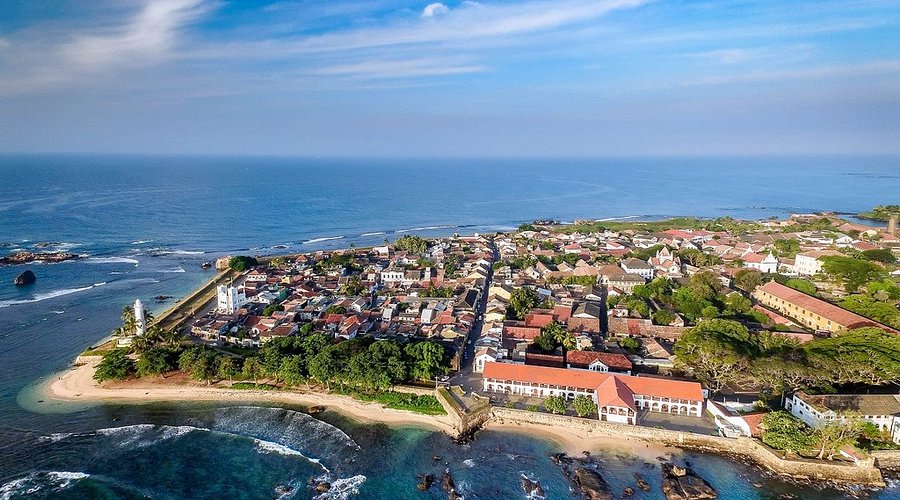
Few places in Sri Lanka combine history and atmosphere quite like Galle Fort. Perched on a rocky promontory on the southwest coast, it's one of the best-preserved examples of a European-built fortified city anywhere in South Asia — and still a living, breathing town rather than a museum piece.
A Layered History
The fort's story began in 1588, when Portuguese forces built a simple earth-and-palisade structure called Santa Cruz after being pushed back to Galle by Sinhalese King Raja Singha I. When the Dutch captured the fort in 1640, they judged the Portuguese defenses too weak and set about encircling the entire peninsula with stone ramparts and bastions, with much of that construction completed by 1663 and the sea wall finished in 1729. The British took over in 1796 and held it until Sri Lankan independence in 1948, adding a lighthouse and a clock tower along the way but largely preserving the Dutch core.
In 1988, UNESCO inscribed the site as a World Heritage Site under the name "Old Town of Galle and its Fortifications," recognizing it as the best surviving example of a fortified city built by Europeans in South and Southeast Asia. The fort has endured for well over four centuries, even withstanding the 2004 Boxing Day tsunami with only limited damage to its walls.
What to See Inside the Fort
- The Ramparts — a roughly 3km walking loop atop the fortification walls, best done near sunset for ocean views over the Indian Ocean
- Galle Lighthouse — perched on the Utrecht Bastion, one of the most photographed spots in the fort
- Dutch Reformed Church — a Baroque-style church built in 1775, still standing at the heart of the old town
- National Maritime Museum — housed in a former Dutch warehouse, covering the region's maritime and archaeological history
- The Main Gate — the fort's original entrance, still bearing colonial-era emblems from both the Dutch and British periods
- Cobblestone streets lined with boutique shops, galleries, and cafes housed in centuries-old buildings
Getting a Feel for the Town
Galle Fort covers about 52 hectares, and it's compact enough to explore comfortably on foot in half a day, or by rented bicycle if you'd rather cover more ground. Traffic inside the fort walls is minimal, making it a pleasant, walkable break from a longer road trip.
Getting to Galle from Colombo
Galle sits roughly 113km southwest of Colombo, an easy drive along the Southern Expressway that typically takes under two hours. A self-drive rental gives you the flexibility to stop at coastal viewpoints along the way, and to continue further along the south coast afterward — see our guide to popular destinations around Sri Lanka for ideas on extending the trip toward Mirissa or beyond.
Best Time to Visit
Galle sits on the south coast, so the same seasonal pattern applies here as elsewhere along Sri Lanka's southwest — the driest, clearest months generally run from December to March. For the full regional breakdown, see our guide on the best time to visit Sri Lanka.
Ready to explore Galle Fort and the south coast?
Book Your Self-Drive Rental with iWay →Final Thoughts
Galle Fort earns its UNESCO status not just for its walls, but for how naturally history and everyday life sit side by side here — locals going about their day inside 400-year-old ramparts. Whether it's your first stop on a south coast road trip or a quiet afternoon detour, it's one of the most rewarding places to slow down and wander in all of Sri Lanka.


