So you're planning to explore Sri Lanka behind the wheel — winding through tea country, cruising the southern coast, or just getting around Colombo on your own schedule. Before you pick up the keys to a rental car, there's one piece of paperwork you need to sort out: proof that you're legally allowed to drive here.
A lot of visitors search for an "international driving licence in Sri Lanka," but the terminology trips people up. You don't actually obtain an International Driving Permit (IDP) in Sri Lanka — it has to be issued by your home country before you travel. What you can get in Sri Lanka is local recognition for that IDP, or a temporary Sri Lankan driving licence if you never got an IDP at all. Here's exactly how that works.
The quick answer
To drive legally in Sri Lanka as a foreign visitor, you need one of the following:
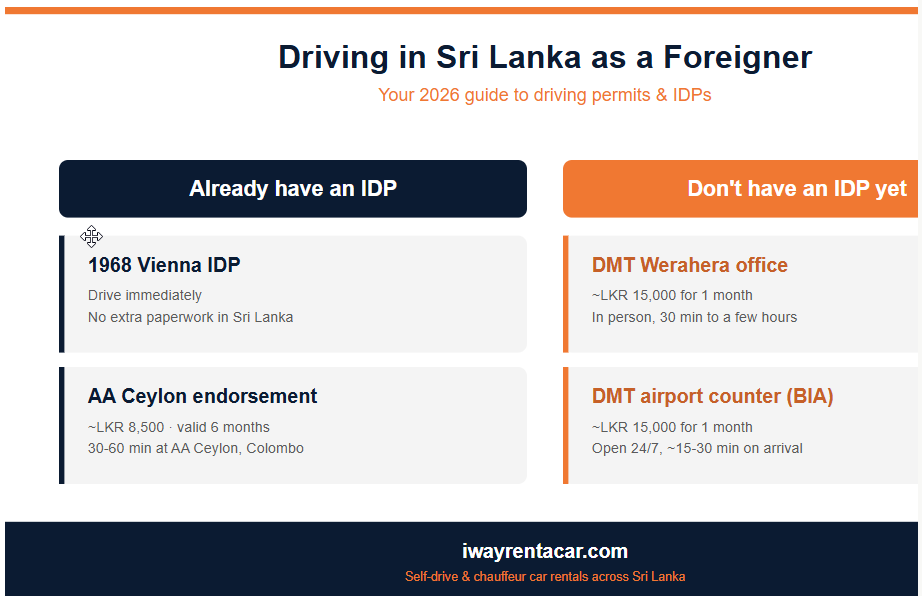
- An IDP issued under the 1968 Vienna Convention — this is recognised on its own, no extra steps required.
- An older IDP (1949 Geneva or 1926 Paris Convention) endorsed by the Automobile Association of Ceylon (AA Ceylon).
- A temporary driving licence issued by the Department of Motor Traffic (DMT), based on your home-country licence, if you don't have an IDP at all.
Any one of these three is enough. None of them work as a standalone document without your original home-country driving licence — always carry both together.
Step one: sort your IDP before you fly (if you can)
If your home country issues 1968 Vienna Convention IDPs — most of Europe, the UK, Australia, Canada, and many others do — apply for it through your national motoring association before you leave. It typically takes anywhere from a day to a couple of weeks, so don't leave it to the last minute. With this document plus your original licence, you can drive in Sri Lanka the moment you land, with no local office visit needed.
If your country only issues older-style IDPs, you'll still need that document, but you'll have to take the extra step below once you arrive.
Step two (if needed): get it recognised once you're here
Option A — AA Ceylon endorsement
If you're holding an IDP that isn't the 1968 Vienna type, take it to the Automobile Association of Ceylon office in Colombo. They'll add an official endorsement that makes it valid for driving in Sri Lanka. You don't strictly need to go in person — a representative (including most reputable rental companies) can submit it on your behalf.
What you'll need: your IDP, passport, visa, and two passport-sized photos. It's usually processed over the counter in around 30–60 minutes, costs roughly LKR 8,500, and stays valid for up to six months.
Option B — DMT temporary driving licence
No IDP at all? You can still drive legally by getting a temporary licence directly from the Department of Motor Traffic, based on your original home-country licence. There are two places to do this:
At the airport (fastest): The DMT now runs a 24/7 counter in the arrivals walkway at Bandaranaike International Airport (BIA), right next to the SPAR supermarket. You can apply the moment you land — present your licence, passport, and visa, fill out a short form, pay the fee, and you'll have your permit in about 15–30 minutes.
At the Werahera office: If you're already in the country, the DMT's main office in Werahera (about 45 minutes from Colombo) processes the same temporary licence. Head to Building H. It's a straightforward process but can take anywhere from 30 minutes to a few hours depending on how busy the office is.
Either way, fees are based on how long you want the licence to be valid:
| Validity period | Fee (LKR) |
|---|---|
| Up to 1 month | 15,000 |
| Over 1 month, up to 2 months | 21,000 |
| Over 2 months, up to 6 months | 30,000 |
| Over 6 months, up to 12 months | 45,000 |
Documents to bring, no matter which route you take
- A full, valid driving licence from your home country — learner's, provisional, or probationary licences aren't accepted.
- Your licence needs to be in English, or accompanied by an official translation.
- Your licence should have at least a year of validity left from your application date.
- A valid passport and visa.
- Your IDP, if you have one.
- Two passport-sized photos (for the AA Ceylon endorsement specifically).
A few things that catch travellers out
Tuk-tuks need a separate endorsement. A standard car/scooter permit doesn't automatically cover three-wheelers — you'll need an additional endorsement from AA Ceylon or DMT specifically for that vehicle class.
Office hours matter. Both AA Ceylon and the DMT Werahera office run Monday to Friday, 8:30am to 3:30pm, and close on public and mercantile holidays — check the local holiday calendar before making the trip. The airport counter, by contrast, is open around the clock.
Rental companies will ask to see this before handing over keys. Most legitimate car rental businesses in Sri Lanka — iWay included — won't release a vehicle without a valid permit, both for your protection and because insurance cover typically depends on it.
Insurance follows the permit. If you're ever in an accident without a recognised licence or permit in hand, your insurance claim could be denied. It's not worth the risk for the cost of a permit.
Driving basics once you're road-legal
A couple of local rules worth knowing before you set off: Sri Lanka drives on the left, with the steering wheel on the right. Speed limits are generally 40 km/h in built-up areas, 60 km/h on rural and provincial roads, and 100 km/h on the expressways. Seatbelts are mandatory for everyone in the vehicle, and using a mobile phone while driving is prohibited. Police checkpoints are common, so keep your permit, passport, and rental documents within reach at all times.
Let iWay handle the paperwork for you
If all of this sounds like more admin than you want to deal with on holiday, we get it. When you book a self-drive or chauffeur-driven car with iWay Rent-a-Car, we can talk you through exactly which document path applies to your nationality and help you get sorted before you even land — so the only thing left to plan is where you're driving to first.
This guide reflects publicly available information as of June 2026. Requirements and fees are set by the Department of Motor Traffic and AA Ceylon and can change — always confirm current details with the official DMT or AA Ceylon offices before you travel.


